At the IdeasLab, I had the opportunity to work alongside computer scientists and physicists as we developed projects to probe the nature of mind, agency, and the process of abiogenesis. Many thanks to the John Templeton Foundation for making this trip possible -- I learned so much from my peers and mentors, and it's a week I won't soon forget!
Liam M. Longo
Specially Appointed Associate Professor
Earth-Life Science Institute
Institute of Science Tokyo
Affiliate Research Scientist
Blue Marble Space Institute of Science
Recent News
Highlights
- 2022/06/24Attended John Templeton Foundation IdeasLab in Prague
- 2022/05/20AbSciCon 2022 Invited Talks
- 2022/04/01Promoted to Specially Appointed Associate Professor / A-PI
- 2022/01/14Manuscript Accepted to PLOS Computational Biology
- 2021/08/17Obituary for Danny Tawfik published in Nature Ecology & Evolution
- 2021/08/12Manuscript Accepted to Critical Reviews in Biochemistry and Molecular Biology
- 2021/03/02Manuscript Accepted to PNAS
- View All News→
IdeasLab: Bringing Chemistry, Physics and Computing to Life
AbSciCon 2022 Invited TalksMay 2022
Check out made-for-YouTube versions of the talks here. As these papers are not yet published, the stories are subject to change! A collaboration between my lab and the Metanis Lab (Hebrew University of Jerusalem) about "ambidextrous" protein folds: A peek at some conversations between me and my former Postdoctoral Advisor Shawn McGlynn:

I've been promoted to Specially Appointed Associate Professor at the Earth-Life Science Institute (ELSI) at the Tokyo Institute of Technology! If you are interested protein evolution or metabolism and would like to join the Longo Lab @ ELSI (Master's or PhD level), please drop me a line!
Evidence for the Emergence of β-Trefoils by ‘Peptide Budding’ from an IgG-like β-Sandwich [ Link ] 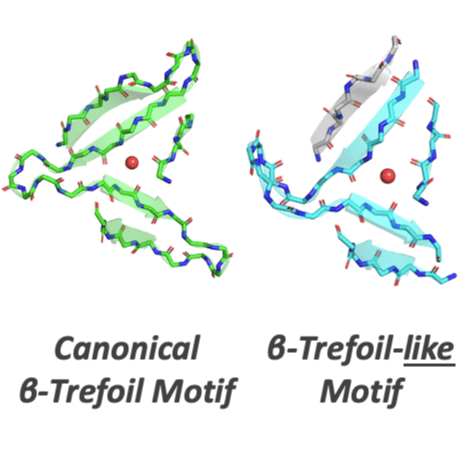
Liam M. Longo*Corresponding or Co-corresponding, Rachel Kolodny*Corresponding or Co-corresponding, Shawn E. McGlynn*Corresponding or Co-corresponding
As sequence and structure comparison algorithms gain sensitivity, the intrinsic interconnectedness of the protein universe has become increasingly apparent. Despite this general trend, β-trefoils have emerged as an uncommon counterexample: They are an isolated protein lineage for which few, if any, sequence or structure associations to other lineages have been identified. If β-trefoils are, in fact, remote islands in sequence-structure space, it implies that the oligomerizing peptide that founded the β-trefoil lineage itself arose de novo. To better understand β-trefoil evolution, and to probe the limits of fragment sharing across the protein universe, we identified both ‘β-trefoil bridging themes’ (evolutionarily-related sequence segments) and ‘β-trefoil-like motifs’ (structure motifs with a hallmark feature of the β-trefoil architecture) in multiple, ostensibly unrelated, protein lineages. The success of the present approach stems, in part, from considering β-trefoil sequence segments or structure motifs rather than the β-trefoil architecture as a whole, as has been done previously. The newly uncovered inter-lineage connections presented here suggest a novel hypothesis about the origins of the β-trefoil fold itself – namely, that it is a derived fold formed by ‘budding’ from an Immunoglobulin-like β-sandwich protein. These results demonstrate how the evolution of a folded domain from a peptide need not be a signature of antiquity and underpin an emerging truth: few protein lineages escape nature’s sewing table.
Dan Salah Tawfik (1955 - 2021): Pioneer of Molecular Evolution [ Link ] 
Liam M. Longo, Dragana Despotović, and Lianet Noda-García
We are deeply saddened by the premature and unexpected passing of our dear friend and mentor Dan Salah Tawfik (דן סלח תופיק). Danny’s contributions to science were immense, and his insights into enzyme catalysis have shaped an array of fields. In this obituary, we try to communicate the impact Danny had on us personally as a mentor, and the joy of doing science in Danny's lab. Photo by David Salem of Zoog Productions.
The evolutionary history of the HUP domain [ Link ] 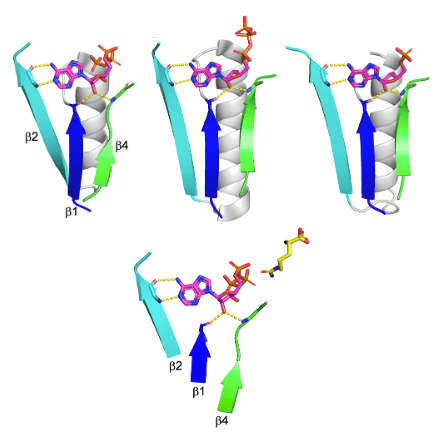
Ita Gruic-Sovulj*Corresponding or Co-corresponding, Liam M. Longo, Jagoda Jabłońska, and Dan S. Tawfik*Corresponding or Co-corresponding
Among the enzyme lineages that undoubtedly emerged prior to the last universal common ancestor is the so-called HUP, which includes Class I aminoacyl tRNA synthetases (AARSs) as well as enzymes mediating NAD, FAD, and CoA biosynthesis. Here, we provide a detailed analysis of HUP evolution, from emergence to structural and functional diversification. The HUP is a nucleotide binding domain that uniquely catalyzes adenylation via the release of pyrophosphate. In contrast to other ancient nucleotide binding domains with the aba sandwich architecture, such as P-loop NTPases, the HUP’s most conserved feature is not phosphate binding, but rather ribose binding by backbone interactions to the tips of b1 and/or b4. Indeed, the HUP exhibits unusual evolutionary plasticity and, while ribose binding is conserved, the location and mode of binding to the base and phosphate moieties of the nucleotide, and to the substrate(s) reacting with it, have diverged with time, foremost along the emergence of the AARSs. The HUP also beautifully demonstrates how a well-packed scaffold com- bined with evolvable surface elements promotes evolutionary innovation. Finally, we offer a scenario for the emergence of the HUP from a seed bab fragment, and suggest that despite an identical architecture, the HUP and the Rossmann represent independent emergences.
Manuscript Accepted to PNASMar 2021
Helicase-Like Functions in Phosphate Loop Containing Beta-Alpha Polypeptides [ Link ] 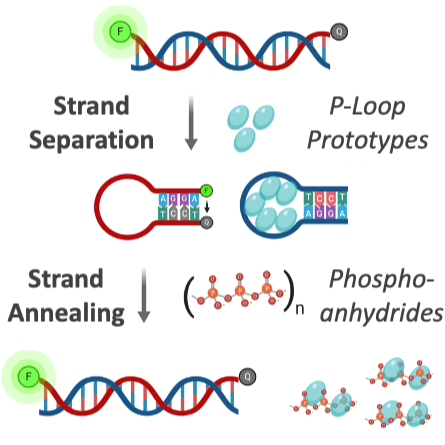
Pratik Vyas, Olena Trofimyuk, Liam M. Longo, Fanindra Kumar Deshmukh, Michal Sharon, and Dan S. Tawfik*Corresponding or Co-corresponding
It is widely assumed that today’s large and complex proteins emerged from much shorter and simpler polypeptides. Yet the nature of these early precursors remains enigmatic. We describe polypeptides that contain one of the earliest protein motifs, a phosphate-binding loop, or P-loop, embedded in a single beta-alpha element. These P-loop prototypes show intriguing characteristics of a primordial world comprised of nucleic acids and peptides. They are ‘generalists’ capable of binding different phospho-ligands, including inorganic polyphosphates and single-stranded DNA. Nonetheless, in promoting double-stranded DNA unwinding and strand-exchange they resemble modern P-loop helicases and recombinases. Our study describes a missing link in the evolution of complex proteins – simple polypeptides that tangibly relate to contemporary P-loop enzymes in sequence, structure and function.